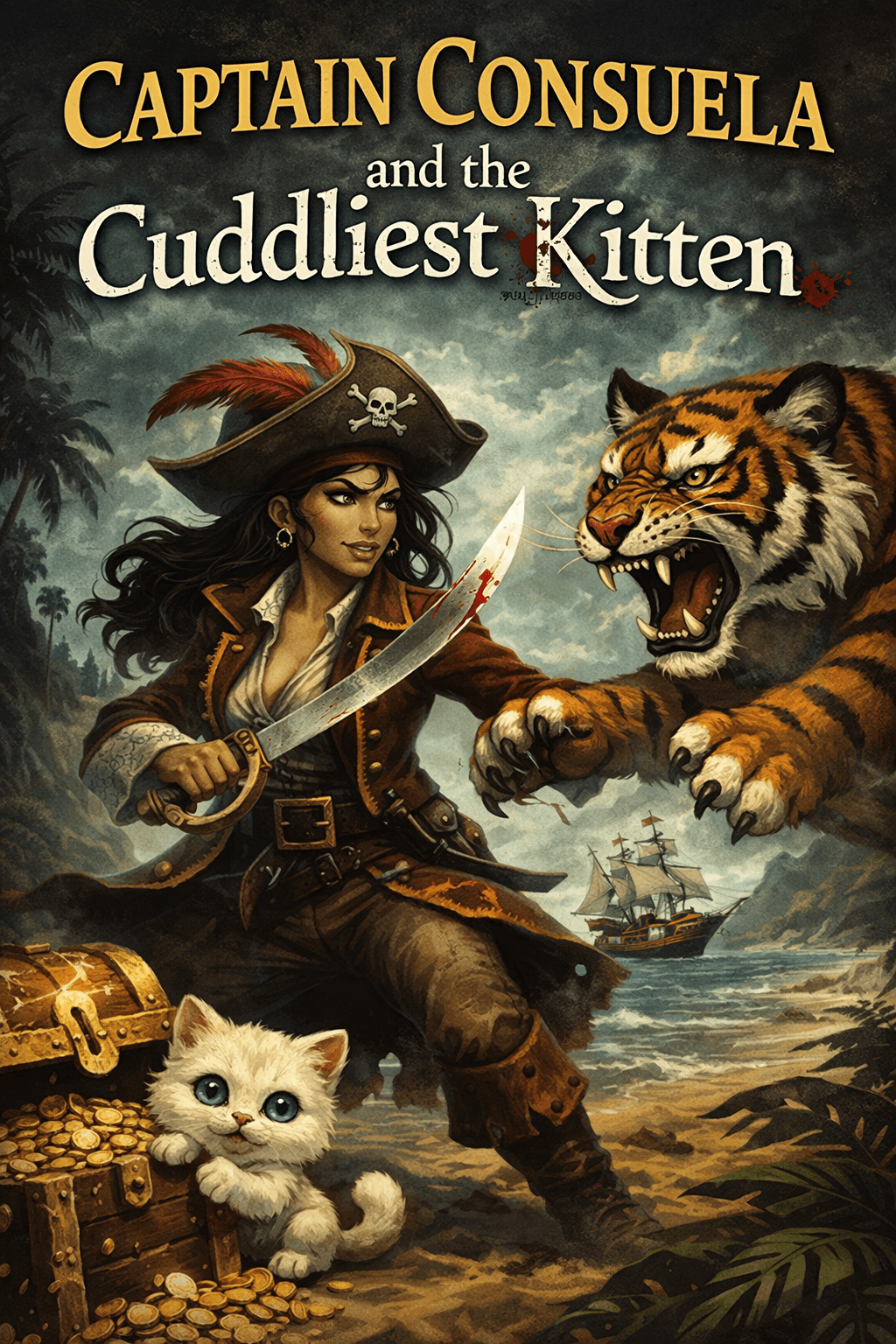
This is the results of the Story Engine Prompt we used in the previous article.
I came up with a ridiculous concept on the spur of the moment (one of my favourite things to do) and plugged it into the Writester Storytelling Prompt and I wanted to share the results to give you an idea of how it worked out.
These results were generated by Claude Sonnet 4.6
The input was I have an idea about a pirate called Consuela the Cat Lady who embarks on a mission to find the worlds fluffiest kitten but its hidden on an island filled with the worlds deadliest tigers and then I used the prompt exactly copied from the previous articles. Then I used Chat GPT for the image on this page.
The Premise
Consuela “The Cat Lady” Villanueva is the most feared pirate on the Amber Sea — not because of her sword arm, but because every crew that’s crossed her has woken the next morning to find their sails shredded, their ropes knotted into incomprehensible shapes, and seventeen cats sitting on their captain’s chest. She collects strays from every port she plunders, and the cats, somehow, always stay.
When a dying harbormaster presses a map into her hand with his last breath and whispers “find Milagro before the Warden does,” Consuela follows the trail to a legend she’s heard only in tavern songs: a single kitten said to have fur softer than cloud-silk, eyes like held candlelight, and a purr that makes even the most broken creature feel briefly, inexplicably safe.
The kitten is on Tiger’s Cradle Island. The most isolated, inaccessible, catastrophically dangerous patch of land in the known world — a volcanic atoll where thirty-seven Bengal tigers the size of warhorses have been bred, trained, and deliberately left wild by the Warden, a shadowy imperial enforcer who has turned the island into a living fortress. Nobody enters. Nobody leaves. Except Milagro, who roams freely among the tigers, untouched.
Consuela is going in anyway.
Theme and Emotional Core
Beneath the swashbuckling, the story asks: What do we do with love when it has nowhere left to go?
Consuela doesn’t simply love animals. She replaced people with them after a loss she has never named aloud. The cats are safe. They don’t leave by choice. They don’t judge. They don’t ask questions she can’t answer. The quest for Milagro seems, on the surface, like glorious absurdity. Beneath it, it’s a grief-driven woman chasing the one thing she believes might make her feel something clean again.
The tigers mirror this theme — creatures of immense power that are most dangerous precisely because they have been denied the one thing they need: freedom. The Warden didn’t create weapons. They created suffering, and called it strength.
The emotional question is: Can someone who has armoured themselves so completely in love for animals finally let another human past the door?
Story Engine
Central question: Can Consuela reach Milagro before the Warden claims the kitten’s power — and survive the island long enough to understand why she came?
She cannot walk away because:
- The harbormaster’s dying words were not a request. They were a warning.
- The Warden is three days behind her with an imperial fleet.
- One of her own crew is hiding a secret connection to the island.
- And somewhere around Act Two, Consuela will realise Milagro isn’t just a legend. The kitten is real. She can feel it.
Every answer the story gives births a sharper question. Every step closer to Milagro costs something personal.
Storyline Structure
A Storyline — The Quest
The primary engine is a race-and-infiltration narrative. Consuela must reach Tiger’s Cradle Island, penetrate its defences, navigate thirty-seven tigers without dying, find Milagro in the island’s interior, and escape before the Warden’s fleet arrives to claim the kitten for imperial use — specifically as a living control mechanism for a new generation of tiger-soldier battalions, since Milagro’s presence makes the tigers docile.
The A storyline drives pace, danger, set-pieces, and forward momentum. It carries the comedy, the action, and the spectacle.
B Storyline — Consuela and Dr. Mira Ashford
Mira is a naturalist who has studied the tigers of Tiger’s Cradle from a careful distance — observing, cataloguing, never interfering. She is exact, controlled, brilliant, and hiding the fact that she was once the Warden’s researcher before she fled. She has information Consuela needs. Consuela has recklessness Mira secretly envies.
Their relationship begins as mutual suspicion — Mira thinks Consuela is going to get everyone killed for a cat; Consuela thinks Mira cares more about her notes than about living things. The emotional truth is that they are the same person wearing different armour. Mira’s detachment and Consuela’s over-attachment are both responses to the same kind of wound.
The B storyline asks whether two people who relate to the world through avoidance can risk trusting each other. It carries the emotional heart of the novel and the reader’s deepest investment.
C Storyline — Rodrigo and the Crew’s Breaking Point
Rodrigo “The Tooth” Salazar is Consuela’s first mate and oldest friend. He has followed her into storms, naval blockades, and once, memorably, a harbor full of angry fishmongers. He has never questioned her. But a ship full of sailors who signed on to plunder merchant vessels did not agree to be eaten by oversized cats — and Rodrigo is quietly keeping a mutiny from happening through sheer force of personality and strategic rum distribution.
The C storyline tracks the crew’s mounting fear and Rodrigo’s private ultimatum: he will hold them together until the island, but if Consuela can’t show them this means something beyond her personal obsession, he cannot promise what comes after. This adds pressure without splitting the narrative focus. It also forces Consuela to lead rather than simply run.
Intersection Rule
All three storylines converge at the island’s interior. The moment Consuela reaches Milagro, Mira reveals her history with the Warden (B breaks into A), and simultaneously, the crew is discovered by the Warden’s advance scouts, forcing Rodrigo’s hand (C crashes into A). Consuela must make a choice that is simultaneously tactical, relational, and emotional — and every choice costs something from a different storyline. This intersection is the novel’s climax engine.
Characters
Consuela Villanueva — “The Cat Lady”
Goal: Retrieve Milagro and deny the Warden a weapon.
Flaw: She has built such complete emotional defences that she expresses love only toward creatures who cannot verbally reject her.
Contradiction: She is ferocious and fearless in action but terrified of quiet conversations.
Secret: Her daughter died three years ago. A fever, too fast for medicine. Her daughter’s last possession was a drawing of a kitten she had never seen but described in perfect detail to Consuela — fur like cloud, eyes like candles, a purr that makes everything feel safe. Consuela has been looking for that kitten ever since, not quite consciously, not quite admitting it.
Voice: Dry, direct, unexpectedly poetic when talking about animals. Deflects with humor when emotionally cornered. Commands rooms without raising her voice.
Rodrigo “The Tooth” Salazar
Goal: Keep the crew alive and keep Consuela from destroying herself.
Flaw: Loyalty as self-erasure — he has never asked for what he wants.
Contradiction: He is the most rational person on the ship and has chosen to spend his life following someone spectacularly irrational.
Secret: He has known what Milagro really is for months. He found the harbormaster’s original letter, read it, and said nothing — because he thought it might finally help her grieve.
Voice: Warm, exasperated, full of elaborate sighs. Gives speeches to the crew that accidentally become quite moving. Very good at de-escalating with food.
Dr. Mira Ashford
Goal: Retrieve her research journals from the island and prevent the Warden from completing their work.
Flaw: She intellectualises everything to avoid feeling it.
Contradiction: She left the Warden’s service because she couldn’t bear what they were doing to the tigers — an act of profound feeling that she has buried under clinical language.
Secret: She created the containment protocol the Warden now uses. The island fortress is her design. She is the reason the tigers can’t leave.
Voice: Precise, slightly formal, with sudden flashes of dry wit she doesn’t seem to intend. Pauses before answering emotional questions as if running a calculation.
The Warden — Señora Pallavra Voss
Goal: Acquire Milagro and complete the tiger-soldier programme.
Flaw: Genuine belief that power without mercy is a form of honesty.
Contradiction: She finds Consuela fascinating rather than threatening, which makes her more dangerous.
Secret: She has tried to reach Milagro herself. Twice. Both times, the kitten simply walked away from her. She needs Consuela to bring it out. She has been steering this quest from the beginning.
Voice: Unhurried, amused, speaks in complete sentences as if dictating a report. Never raises her voice. Extremely polite about terrible things.
Ghost — Consuela’s Senior Ship Cat
A one-eyed, battle-scarred grey tom who has been on the ship longer than anyone except Rodrigo. He communicates entirely through positioning and expression. He does not like Mira at first. The crew treat his opinion as a meaningful data point. He is, in practice, the ship’s morale officer. He will have at least two scenes that make readers genuinely emotional, which is a feature, not an accident.
Character Chemistry
Consuela and Mira — the central relationship. Both protecting themselves. Both drawn to each other’s way of seeing the world. Their dynamic shifts from professional tension to something neither of them has a word for yet. Every conversation contains at least one thing neither of them says. Reader fascination guaranteed.
Consuela and Rodrigo — warm, fractious, years of shorthand. The scene where he tells her he found the letter is a quiet devastation. Their relationship carries the novel’s emotional backbone.
Mira and the Tigers — she knows their names. All thirty-seven. This detail, when revealed, reframes her entire character.
Consuela and Voss — a chess match across the whole novel, fought mostly through intermediaries and implication until the final confrontation. Voss has been a step ahead the entire time and enjoys that Consuela doesn’t know it. The moment Consuela realises she’s been played is one of the best dramatic reversals in the book.
Dialogue Potential
Each major character has a distinct register:
- Consuela: short sentences, vivid animal metaphors, emotional truth disguised as observation
- Rodrigo: long-suffering warmth, tends to summarise the situation accurately and be ignored
- Mira: precise and slightly delayed, like she’s translating from another language
- Voss: gracious and cold, makes violence sound administrative
Key dialogue principle: nobody in this story says what they mean directly, except the cats, who are consistently honest through behaviour. Scenes between Consuela and Mira should always contain a visible argument and a subterranean conversation running beneath it.
Set-Piece Moments
- The Harbormaster’s Map — Opening scene. A dying man, a smoky tavern, and a map drawn in what appears to be cat hair. Consuela’s expression when she realises where the island is. Rodrigo’s expression when she smiles.
- The First Tiger — The crew’s landing party encounters a tiger the size of a small carriage on the beach. It sits down. It looks at Consuela. It begins to groom itself. This is not reassuring. This is somehow worse.
- Mira’s Confession — Midpoint reveal. Mira shows Consuela the original containment blueprints. The scene is quiet and devastating. Consuela’s response is not what Mira expected. Neither is the reader’s.
- The Tiger Court — The island’s interior contains a natural amphitheatre where the tigers gather. Consuela walks into the centre alone, against every instruction, and sits down. The tigers circle. Ghost, who somehow made it off the ship, jumps into her lap. The tigers sit. This is the scene readers will talk about.
- Rodrigo’s Letter — He tells her about the harbormaster’s original message. She doesn’t react immediately. The scene ends. Two chapters later, she sits alone and the narration finally goes where it’s been heading since Chapter One. This is the emotional peak of the B storyline.
- Voss Arrives Early — The Warden’s fleet appears a full day ahead of schedule. Everything accelerates. The crew fractures. Rodrigo earns his chapter.
- Milagro — The moment Consuela finds the kitten. The description matters enormously here. What she does next, and why she does it, is the thematic resolution of the entire novel.
- The Exit — Getting off the island. Mira, the tigers, the fleet, the crew, and one very small kitten. Everything the story has built arrives at once. Chaotic, costly, earned.
Pressure Escalation
- Act One: The quest seems eccentric. The crew is amused. The island sounds dangerous but abstract. Voss is a rumour.
- Act Two opening: The island is real. The tigers are real. Mira’s secrets begin to surface. The Warden sends a message.
- Act Two midpoint: Mira’s confession. The crew’s near-mutiny. Rodrigo’s letter. The cost of the quest becomes personal rather than professional.
- Act Two closing: Voss arrives early. The window closes. Two crew members are injured. Consuela must choose between the mission and the people she has — despite everything — allowed to matter.
- Act Three: Everything converges. The narrative, emotional, and thematic resolutions arrive together. Nobody escapes clean.
Emotional Arc
Beginning: Consuela is functional, funny, capable, and hollowed out. She loves animals because it is safer than loving people. She does not know she is grieving. She thinks she is just particular.
False belief: “I am fine. I just prefer cats.”
Midpoint shift: The grief surfaces, gradually, through her relationship with Mira — who asks the wrong question at the right time — and through Rodrigo’s confession.
End: Consuela does not become a different person. She becomes a more honest version of the same person. She keeps the cats. She also, cautiously, keeps Mira. She names the kitten what her daughter called it in the drawing. The reader will need a moment.
Commercial Story Promise
This novel markets as swashbuckling adventure with genuine heart — it can sit on shelves next to The Princess Bride, The Lies of Locke Lamora, or Terry Pratchett’s more tender work. It has a hook that immediately makes people smile and a premise that holds its emotional depth until readers are already attached and cannot escape it.
The cats are a feature. The grief is the engine. The tigers are a mirror. The adventure is the delivery system.
A reader keeps turning pages because Consuela is magnetic and broken, the island is genuinely dangerous, and somewhere around Chapter Eight, they realise this is not actually a story about a kitten — and they need to know if she’s going to be okay.
What do you think?
 Writester
Leave a comment