You’ve Probably Thought About Writing a Novel
Most people have, at some point.
Maybe you’ve even started one.
A few chapters sitting in a folder somewhere. Or a full draft you’re not quite happy with.
Maybe you ran out of time.
Maybe you lost momentum.
Maybe you just weren’t sure how to take it further.
That’s where a lot of ideas end up.
Things Have Changed
Over the last couple of years, artificial intelligence has quietly worked its way into everyday life.
For a lot of people, it’s made things easier. Faster. More accessible.
Writing is no different.
You can now sit down with an idea and get something on the page almost immediately. Not notes. Not bullet points. Actual prose.
That’s new.
But Let’s Be Clear About One Thing
AI is a tool.
It’s not a magical elf that writes your novel while you sleep.
A better way to think about it is this:
It’s a very powerful assistant
Closer to a supercharged spell checker than a replacement for a writer.
We’ve seen this pattern before.
When typewriters became common, people thought anyone could sit down and produce a novel.
They couldn’t.
The same thing happened with word processors.
And now it’s happening again with AI.
The tools get better.
The fundamentals don’t change.
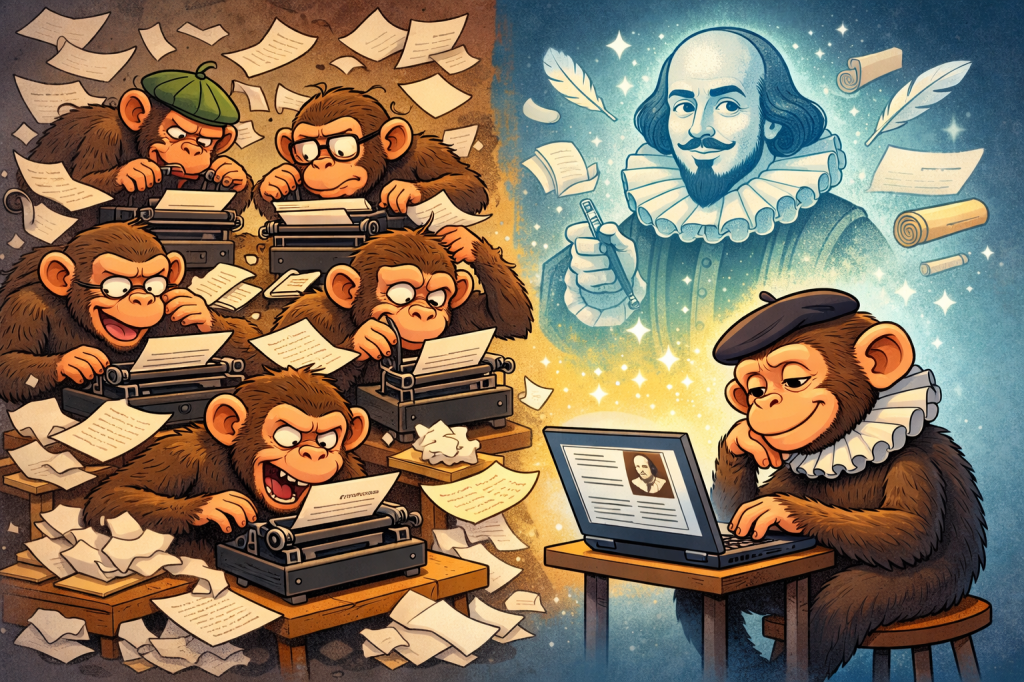
The Monkey Problem
There’s an old idea that if you put a hundred monkeys in front of a hundred typewriters, eventually one of them will produce the works of William Shakespeare.
Give those monkeys AI, and they might get there faster.
But they’ll still produce a lot of noise before anything worth reading appears.
That’s the key point.
More output doesn’t mean better writing.
So What’s the Difference Now?
Used properly, AI can do things that weren’t possible before.
It can:
- generate ideas
- explore variations
- help shape scenes
- sharpen what’s already there
Used poorly, it produces exactly what you’d expect:
safe, generic, forgettable writing
The difference isn’t the tool.
It’s the way it’s used.
The Approach We’re Taking Here
There’s a simple principle that sits behind everything on this site:
Human first. Human last.
You bring:
- the idea
- the direction
- the decisions
AI helps with:
- execution
- expansion
- refinement
That balance matters.
What We’re Going to Do
We’re not here to generate endless text and hope something sticks.
We’re going to build something properly.
Starting with:
- turning a small idea into something usable
- shaping that into a story
- building structure around it
- and carrying it through to a finished novel
Along the way, we’ll cover:
- character creation
- dialogue
- story structure
- and the systems that keep everything consistent
Everything you need to create a novel that actually works.
Let’s Start Simple
Before structure, before planning, before anything complicated…
You need something to work with.
Let’s create that.
(Insert your villain generator prompt here)
Create a compelling fictional villain character.
Requirements:
- Give them a clear name and role
- Define their core motivation (what they want and why)
- Include a hidden contradiction or weakness
- Show how they justify their actions (they should not see themselves as the villain)
- Describe how others perceive them vs who they really are
Include:
- a short character profile
- a brief backstory
- 3 distinctive personality traits
- 2–3 lines of dialogue that capture their voice
The character should feel original, believable, and suitable for a novel.
What Comes Next
Getting something interesting on the page is the easy part.
Keeping it consistent is where most people struggle.
If you’ve already tried writing with AI, you’ll know the feeling.
We’ll tackle that next.
 Writester
Leave a comment