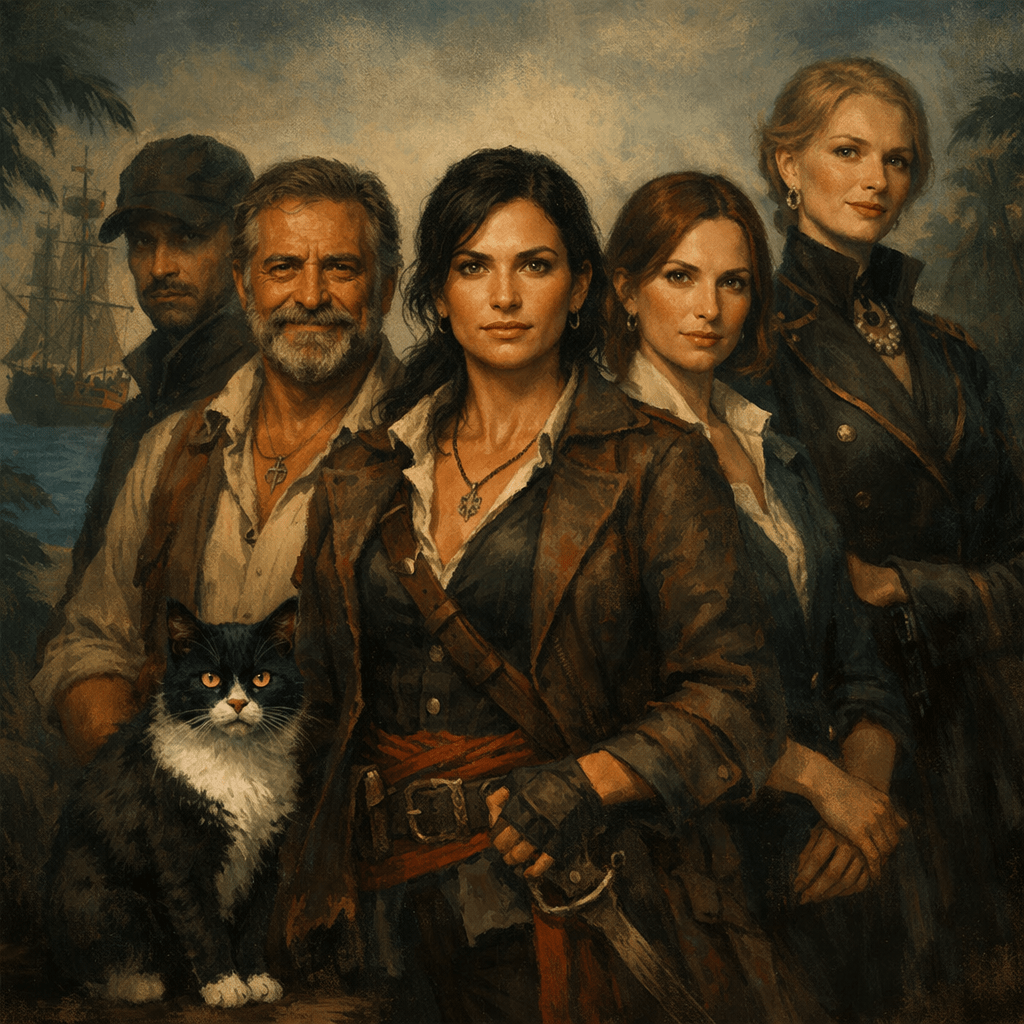
Here are the results from the Character Foundation prompt. I jsut continued the ridiculous idea about Captain Consuela and the cuddlly kitten, it will give you an idea of the kind of results to expect.
Consuela Villanueva — “The Cat Lady”
Story Role: Protagonist. The emotional and narrative centre of the story. Every major plot event either tests her, reveals her, or forces her to change.
Archetype: Hero — but one who has mistaken endurance for healing and motion for purpose.
Goal (Surface): Reach Tiger’s Cradle Island, retrieve Milagro, and deny Voss a weapon.
Motivation (True): Her daughter, Elena, died three years ago and left behind a drawing of a kitten she described with startling specificity — cloud-soft fur, candlelight eyes, a purr that makes everything feel safe. Consuela has been searching for that kitten without fully admitting to herself that grief is the compass. Retrieving Milagro is the only act of love she has left that feels like it could mean something.
Flaw: She channels all capacity for emotional intimacy into animals because they cannot choose to leave. She is generous, funny, and magnetic — and completely unavailable to anyone who tries to get close. She mistakes this for independence. It is, in fact, a very sophisticated kind of hiding.
Secret: Elena. Almost nobody knows she had a child. Rodrigo knows. Nobody else does. The drawing is in an oilskin wallet she keeps inside her coat, against her chest. She has never shown it to anyone.
Arc: Begins as someone performing wholeness. Ends as someone beginning, carefully, to actually feel it. She does not transform — she reopens. The cost is enormous and the reward is real. She arrives at the novel’s end still prickly, still piratical, still surrounded by cats, but no longer sealed.
Character Voice: Short, precise sentences with sudden detours into unexpected lyricism when she talks about animals or the sea. Deflects emotional pressure with dry humour and apparent subject changes. In command: calm, decisive, unsettling. In private: quieter than anyone expects. She has a habit of describing people in terms of animals when she is working out whether she trusts them.
“You move like a cat that’s been shut in a room. Contained. Watching the door.”
(to Mira, Chapter Four)
Emotional Layer: Readers will trust her immediately, feel her warmth, laugh with her — and then register the silence behind the performance. The grief surfaces slowly enough that when it arrives fully, it lands hard.
Relationship Tension:
- With Rodrigo: deep mutual understanding that occasionally becomes mutual frustration; he is the only person she allows to see near the truth of her
- With Mira: the central relationship engine; Consuela recognises something in Mira she won’t name, and spends the first half of the novel being irritated about it
- With Voss: a chess match; Consuela is the better improviser, Voss is the better planner, and this dynamic defines the antagonist structure
- With Ghost: the cats are where her emotional honesty lives; Ghost watching Mira and eventually accepting her is a more significant indicator of trust than anything Consuela says directly
Rodrigo “The Tooth” Salazar
Story Role: Key Ally and Emotional Anchor. He is the bridge between Consuela’s internal world and the reader. He holds the crew together, holds Consuela’s history, and holds the secret that breaks the story open at its midpoint.
Archetype: Ally shading into Herald. He doesn’t announce the journey — he enables it. The moment he reveals the letter, he becomes the one who finally names what everything has been about.
Goal (Surface): Keep the crew functional, keep Consuela alive, and get everyone home.
Motivation (True): He has watched Consuela survive without healing for three years and quietly decided that Milagro — real or not — might be the thing that finally lets her grieve properly. He found the harbormaster’s original letter, understood what it implied, and said nothing, because he hoped it would lead her somewhere she needed to go.
Flaw: Loyalty as self-erasure. He has spent years making himself useful and steady and indispensable, and has never once asked the question: what do I want? When this surfaces, it doesn’t come out as resentment — it comes out as a kind of sadness that is more affecting than anger would be.
Secret: He found and read the harbormaster’s original correspondence weeks before the dying man pressed the map into Consuela’s hands. He engineered their presence in that harbour. He has been, with deep affection and good intentions, quietly orchestrating this whole mission — and Consuela will feel that as a betrayal before she feels it as love.
Arc: Rodrigo begins as the most functionally stable person in the story. By the midpoint, the secret is out, and he is no longer simply the anchor — he is a person asking to be seen. The final act gives him the thing he has never asked for: an honest conversation with Consuela about what he needs. Whether that conversation goes well is part of the emotional texture of the ending.
Character Voice: Warm, elaborate, fond of extended sighs. He gives speeches that accidentally become genuine. He is good at de-escalation, terrible at confrontation, and deeply aware of both things. In difficult moments he reaches for food — offering it, preparing it, discussing it — as a form of emotional management. His dialogue tends to circle what he means before landing on it.
“I’m not saying it’s a bad plan. I’m saying it’s the kind of plan that ends songs. And not the cheerful kind.”
Emotional Layer: Readers like Rodrigo immediately and completely. He is the character most likely to be missed in scenes he doesn’t appear in. His midpoint reveal recontextualises everything and makes readers reassess who he is — which is the correct response.
Relationship Tension:
- With Consuela: decades of shorthand, genuine love, a secret that changes the flavour of everything that came before it
- With the Crew: a living morale system; they follow him when they’ve stopped following Consuela, which makes him a political force as well as a loyal one
- With Mira: cautious. He watches her around Consuela. He is protective. Eventually, he tells her something that Consuela hasn’t said directly, and this becomes one of the novel’s quieter pivots.
Dr. Mira Ashford
Story Role: Key Ally and emotional counterpart to Consuela. She carries the B storyline, the island’s backstory, and the novel’s central relationship tension.
Archetype: Shapeshifter. She presents as detached, clinical, and coolly professional. The story progressively reveals this as performance — not deception, but armour. She shifts in the reader’s perception from potential obstacle to necessary partner to the emotional centre of the book’s second half.
Goal (Surface): Retrieve her research journals from the island and prevent the Warden from completing the tiger-soldier programme.
Motivation (True): Guilt. The island’s containment system — the fortress structure that traps the tigers, the layout that makes it impenetrable, the protocols Voss now uses — is her design. She built it in service of research she believed was conservation. She was wrong about what she was building, and wrong about who she was building it for. Returning to the island is an act of incomplete but genuine penance.
Flaw: She intellectualises everything as a mechanism for not feeling it. She is brilliant, observant, and emotionally processing events approximately six weeks after they happen. This makes her precise and infuriating and, once the layers come off, unexpectedly vulnerable.
Contradiction: The most controlled character in the story made the single most consequential emotional decision — leaving the Warden’s service — on pure instinct and feeling, and has never fully reconciled those two versions of herself.
Secret: She designed the containment protocol. The island is her architecture. She knows every tiger’s name, every entry point, every weakness — because she built the whole system herself. She is not just a useful guide. She is the key. This revelation, when it comes, must be handled carefully because it reframes her as either a critical asset or a profound liability, and Consuela will feel it as both simultaneously.
Arc: Begins as the most apparently closed character in the story. Ends as the one who has moved furthest. She arrives clinical and exits with her hands, metaphorically, unclenched. The relationship with Consuela is the mechanism of this change, but so is what happens in the tiger court — being seen by the animals she named is different from being observed by them.
Character Voice: Precise and slightly formal, with sentence rhythms that suggest she edits herself before speaking. Occasional dry wit that arrives unexpectedly, as if surprising her as much as anyone else. She pauses before answering emotional questions with the quality of someone running a quick internal calculation. Her vocabulary when talking about the tigers shifts register entirely — warmer, more specific, more alive.
“Thirty-seven. I know all their names. I realise that doesn’t make what I did better. I’m aware.”
Emotional Layer: Readers will find Mira harder to access than Consuela initially, which is intentional. The gradual opening of her character is a sustained pleasure. By the midpoint, readers are more invested in her than they expected to be and slightly annoyed about it.
Relationship Tension:
- With Consuela: the central current of the novel; two people with the same wound expressed in opposite directions, orbiting each other with increasing inevitability
- With Voss: former employer, current pursuer, source of the guilt she carries; their confrontation in the final act is one of the most charged scenes in the book
- With the Tigers: she knows them. This detail, when revealed, is the moment readers fully understand who Mira actually is.
- With Ghost: the ship’s cat doesn’t trust her at first. His eventual acceptance is treated with full narrative seriousness.
Señora Pallavra Voss — The Warden
Story Role: Primary Antagonist and Opposing Force. She is not a villain in the traditional sense — she is a person with coherent goals, genuine intelligence, and a complete absence of the particular kind of conscience that might have made her better. She makes the world more dangerous by being right about some things.
Archetype: Shadow. She reflects Consuela — specifically, what Consuela might have become if grief had moved toward control rather than flight. Voss has also lost something. She responded by deciding she would never be subject to loss again.
Goal (Surface): Acquire Milagro, complete the tiger-soldier programme, and expand imperial reach through a new class of controllable military asset.
Motivation (True): Voss believes that the world is organised by force and that the only honest position is to control that force rather than pretend otherwise. She is not cruel for pleasure. She is cruel because she has decided cruelty is simply the visible part of power, and power is simply the visible part of order, and order is the thing that prevents the kind of chaos that once unmade her.
Flaw: She is so committed to control that she cannot account for the genuinely uncontrollable — and Consuela, and the cats, and Milagro itself are all, in different ways, beyond her system. This is not a weakness she can fix. It is a structural one.
Secret: She has tried to reach Milagro twice. Both times, the kitten simply walked away. Not in fear — in disinterest. This has unsettled her more than she would admit, because it suggests there is something her system cannot categorise: a creature that chooses freely and cannot be compelled. She needs Consuela to bring Milagro out because she cannot do it herself. She has been steering this quest from the beginning — the dying harbormaster, the map, the timing — and Consuela is, without knowing it, her instrument.
Arc: Voss does not change. This is intentional and correct. Her consistency is what makes her frightening. What changes is Consuela’s understanding of her — and the reader’s gradual recognition that Voss has been three moves ahead the entire time.
Character Voice: Unhurried, gracious, slightly amused. She speaks in complete sentences with the rhythm of someone dictating a formal document. She never raises her voice. She announces terrible things with the same tone as weather observations. Her politeness is not a mask — it is genuine, which is more unsettling than if it were calculated.
“I don’t need to catch you, Captain Villanueva. I just need you to finish what you’ve started. Which, knowing your reputation, seems nearly certain.”
Emotional Layer: Readers should find Voss fascinating rather than simply hateable. She is the character most likely to make readers uncomfortable because some of what she says is accurate. Her reveal as the architect of the quest creates genuine retroactive dread.
Relationship Tension:
- With Consuela: mutual respect structured as opposition; Voss finds Consuela genuinely interesting, which Consuela correctly identifies as more dangerous than contempt
- With Mira: employer and defector; there is a history here that the story reveals in stages
- With the Mission: she has already won, potentially, before the story begins — and the question is whether Consuela can break the shape of a plan that’s been running longer than she knew
Ghost — Senior Ship’s Cat
Story Role: Threshold Guardian and Moral Compass. Ghost does not speak. He does not need to. He is the character through whom the emotional temperature of every scene can be read at a glance.
Archetype: Threshold Guardian, with moments of Herald. He guards the threshold of Consuela’s trust. When he accepts someone, it matters. When he doesn’t, it matters equally.
Goal: Ship safety, personal dignity, access to the best sleeping spots.
Motivation: Obscure, as with all cats. Loyalty expressed entirely through presence rather than statement.
Flaw: He has very poor opinions of most people and is frequently correct. This occasionally causes diplomatic incidents.
Secret: He was Elena’s cat first. He came aboard the ship the week after she died. Consuela has never told anyone this.
Arc: Ghost’s arc is a character measurement device. The novel can track the progress of every major relationship through his behaviour. His acceptance of Mira is a major emotional beat. His presence in the tiger court changes what that scene means. His first meeting with Milagro is the closest the novel gets to magic realism, and the scene must be written carefully enough that it earns it.
Character Voice: Expressed entirely in action, position, and expression. He communicates volumes. The crew interprets him with complete seriousness and some accuracy. He is the most emotionally honest character in the story and cannot be manipulated.
Emotional Layer: Ghost will make readers cry at least once. This is not a risk. It is a guarantee. Plan accordingly.
Tomas Vare — The Warden’s Field Agent
Story Role: Secondary Tension and Threshold Guardian. He is Voss’s presence on the ground before she arrives herself — the human face of her operation, tasked with following Consuela’s crew at a careful distance and reporting back. He is also, quietly, losing faith in what he’s been asked to do.
Archetype: Shapeshifter, moving between threat and possible complexity.
Goal (Surface): Track Consuela’s progress and ensure she delivers Milagro to Voss.
Motivation (True): He has followed Voss for twelve years and believed in the programme’s stated purpose. The island changed something. He has seen what the tigers actually are — not weapons, but prisoners — and the cognitive dissonance has been building.
Flaw: He mistakes loyalty for identity and does not yet know how to be a person without a directive.
Secret: He has already sent one message to Voss and partially written a second, and then stopped. The second message would have warned Consuela. He deleted it. He has not stopped thinking about this.
Arc: Tomas is the character who shows what Voss’s order costs the people who serve it. He may help, in the final act, at real personal cost — or he may not, which is also true to his character and the story’s honesty about how difficult it is to break a long loyalty.
Character Voice: Careful, professional, with a flatness that occasionally breaks into something more human when he thinks nobody is watching. He and Rodrigo share at least one scene alone that becomes unexpectedly interesting.
Relationship Map
| Pairing | Dynamic | Narrative Function |
|---|---|---|
| Consuela / Rodrigo | Love, history, hidden wound | Emotional backbone of the story |
| Consuela / Mira | Tension, recognition, slow trust | Central relationship engine |
| Consuela / Voss | Respect, opposition, predator chess | Antagonist structure |
| Mira / Voss | Guilt, flight, unfinished accounting | B storyline accelerant |
| Rodrigo / Crew | Loyalty under strain | C storyline engine |
| Ghost / Mira | Suspicion to acceptance | Emotional thermometer |
| Ghost / Elena (absent) | Memory, grief, inheritance | Secret layer of the whole story |
Emotional Layer Summary
- Who readers trust immediately: Consuela, Rodrigo
- Who earns trust gradually: Mira
- Who creates productive unease: Voss, Tomas
- Who creates pure emotional pull: Ghost, and the absent Elena whose presence shapes everything
- Who creates instability: Rodrigo’s secret, Mira’s confession, Voss’s long game
 Writester
Leave a comment