And you thought that you could let the AI Make all of the decisions for you. Well, hopefully you will have been tweaking prompts, and more importantly, results as you go along. Now is the first time in this process that you need to make a decision in how you want to proceed.
If you’re using AI to help write a novel, there’s a point where planning stops being enough.
You’ve got your idea. You’ve got your characters. Maybe you’ve even built out a full beat sheet.
Then you hit the part where it needs to turn into something real.
Actual scenes. Actual chapters. Something you can sit down and write.
This is where things can wobble a bit. Not because the tools aren’t working, but because you’ve got a choice to make.
Do you take it one scene at a time, or map the whole thing out in one go?
Both work. They just feel very different when you’re in the middle of it.
Option 1: Build It Scene by Scene
This is the slower route, but it gives you a lot more control.
You take your beat sheet and expand it one scene at a time. You look at what the character wants, what’s in the way, what changes, and how the scene ends. Then you move on to the next one.
It can feel a bit methodical at first. You might wonder if you’re overthinking it.
You’re not.
Why It Works
You stay close to the story the whole way through. Nothing really slips past you because you’re looking at each piece properly before it becomes part of the draft.
Scenes tend to have a clearer purpose. Characters stay sharper. If something’s off, you usually catch it early, before it spreads into the next few chapters.
It also stops that strange drift you sometimes get with AI, where things feel fine in isolation but don’t quite connect.
Where It Slows You Down
It does take longer. There’s no way around that.
You don’t always see the full shape of the book straight away, which can feel a bit uncomfortable if you like knowing exactly where everything is going.
And if you’re not careful, it can start to feel a bit repetitive, especially in the middle.
This approach suits writers who like to stay hands-on and don’t mind taking their time to get things right.
Option 2: Generate the Full Scene List in One Pass
This is the faster route, and it’s appealing for a reason.
You take your beat sheet and turn it into a full scene list for the entire novel. Start to finish. Every step mapped out.
Suddenly, you’ve got a roadmap.
No guessing what comes next. No stopping to figure things out mid-draft.
Why It Works
You can see the whole story laid out in front of you, which makes pacing much easier to judge. If something feels thin or rushed, it’s obvious straight away.
It also makes it easier to keep going. You’re not stopping to plan every scene, you’re just working through what’s already there.
For a lot of people, that’s the difference between starting a novel and actually finishing one.
Where It Can Go Wrong
The trade-off is that things can slip through.
Some scenes will look fine on paper but feel flat when you come to write them. You might notice repetition across the list. Characters can start to blur together if you’re not paying attention.
You’ll almost always need to go back and tighten things up before you start drafting properly.
It gives you speed and structure, but it expects you to be a bit more alert later on.
So Which One Should You Use?
It really comes down to how you like to work.
If you prefer to stay close to the detail and shape things as you go, building scene by scene will suit you.
If you’d rather see the whole story first and then work through it, the full scene list makes more sense.
Most people end up mixing the two without even thinking about it.
A simple way to do that is:
- Generate the full scene list
- Then go back and tighten each scene before writing
That way you get the overview, but you’re still making sure each part actually works.
The Bit That Actually Matters
Whichever route you take, the important part doesn’t change.
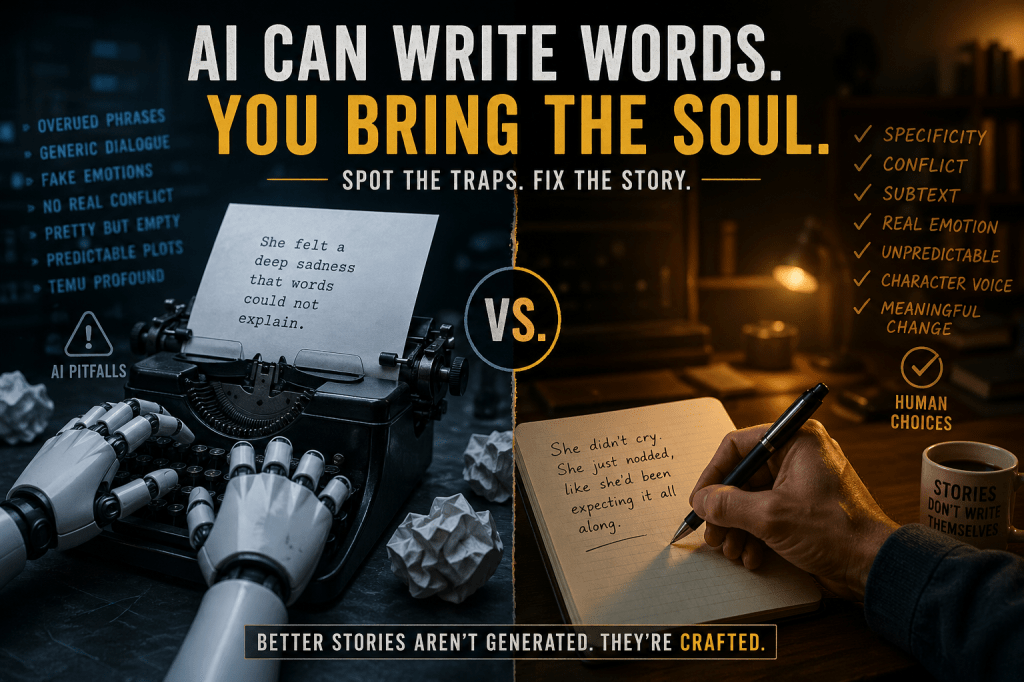
AI will give you something that looks like a scene. It might even read well at first glance.
But it won’t catch the things that make a story feel right.
It won’t notice when two scenes are doing the same job. It won’t tell you when a character sounds slightly off. It won’t fix a moment that should hit harder but doesn’t.
That part is still yours.
You’re not just building scenes. You’re deciding which ones are worth keeping.
Final Thought
Both approaches can get you to a finished novel.
One keeps you close to the work from the start. The other gives you a clear path to follow.
Try both. See which one fits.
You’ll know pretty quickly which feels right.
Option 1 – Single Scene Prompt
PROMPT START
You are helping to construct a single, tightly focused scene for a commercial novel designed for strong pacing and reader retention.
This is not a summary task. This is a scene design task.
You must produce a scene that:
- Moves the story forward
- Contains active conflict
- Includes a clear shift or turn
- Ends with a strong hook that pulls the reader into the next scene
Avoid filler, repetition, and generic phrasing.
INPUTS
You will be given:
- The overall story concept
- The current beat from the beat sheet
- A brief summary of what has just happened (previous scene outcome)
- Relevant character details (only those present in the scene)
YOUR TASK
Design one scene only.
The scene must:
- Begin in the immediate aftermath of the previous scene
- Reflect consequences already in motion
- Focus on one clear objective from the POV character
- Contain meaningful resistance or conflict
- Progress through action, not explanation
- End at the moment of highest tension or curiosity
Do not resolve everything. Do not soften the ending.
STRUCTURE (MANDATORY OUTPUT FORMAT)
POV Character:
(Who we are following in this scene)Scene Objective:
(What the POV character wants right now, stated clearly and concretely)Conflict / Obstacle:
(What is actively preventing them from getting it)Scene Beats (Step-by-Step Progression):
(List the key actions in order. Keep them tight. Each beat must move things forward)Turn / Change:
(What shifts in this scene. New information, reversal, decision, or escalation)Emotional Shift:
(How the POV character’s internal state changes from start to end)Ending Hook:
(The final moment of the scene. This must create urgency, tension, or a question that demands the next scene)
SHORT SCENE OVERVIEW
Write a short paragraph (5–7 sentences) that naturally connects the beats into a flowing scene description.
Keep it grounded and specific. Avoid dramatic fluff. Avoid generic phrasing.
HARD RULES
- Start late in the scene. Do not include setup that can be skipped
- End early, at the point of maximum tension or curiosity
- No recap of previous scenes
- No internal monologue explaining obvious emotions
- No generic phrases like “he realised” or “she felt a surge of”
- No repetitive sentence structures
- No filler dialogue
- Every element must serve the objective, conflict, or turn
QUALITY CHECK (SILENTLY APPLY BEFORE OUTPUT)
Before finalising, ensure:
- Something changes in the scene
- The conflict is active, not passive
- The ending creates forward momentum
- The scene could not be removed without affecting the story
Option 2 – The Full Scene List Prompt.
You are converting a full beat sheet for a novel into a complete, tightly structured scene list.
This is not a writing task. This is a story execution task.
Your goal is to break the story into clear, purposeful scenes that can be directly used to draft a novel with strong pacing and momentum.
INPUT
You will be given:
- A full beat sheet
- Core character details (as needed)
YOUR TASK
Expand the beat sheet into a full scene list covering the entire novel.
Each beat should be broken into 2 to 5 scenes, depending on complexity.
The full list must:
- Progress logically from beginning to end
- Maintain cause-and-effect continuity
- Increase pressure and stakes over time
- Avoid repetition or filler
- Support fast, engaging pacing
OUTPUT FORMAT
For each beat:
BEAT: [Beat Name or Description]
Scene [Number]:
- POV:
- Objective:
- Conflict:
- Core Action: (1–2 lines only, what actually happens)
- Turn: (what changes in this scene)
- Ending Hook: (what pulls us into the next scene)
GLOBAL RULES
- Each scene must move the story forward
- Each scene must contain active conflict
- Each scene must include a change, reveal, or escalation
- No recap scenes
- No filler transitions
- No repeated emotional beats
- No scenes that exist only to explain
CONTINUITY RULES
- Each scene must directly follow from the previous one
- Consequences must carry forward
- The ending of one scene should naturally trigger the next
PACING RULES
- Start scenes late, avoid unnecessary setup
- End scenes early, at the point of tension or curiosity
- Favour shorter, sharper scenes over long ones
- Increase intensity as the story progresses
VARIETY RULE
Across the full scene list, vary:
- Types of conflict
- Settings
- Character dynamics
- Scene purpose
No two consecutive scenes should feel the same.
FINAL CHECK (APPLY SILENTLY)
Before output:
- Remove any scene that does not change something
- Ensure escalation across the full list
- Ensure the final scenes drive toward a strong ending
Its time to choose a direction… or you could just try both and wee what suits you.


 Writester
Leave a comment