One of the things I always find interesting about AI writing prompts is that the real magic usually happens after the planning stage.
It’s easy to generate outlines. Easy to brainstorm ideas. Easy to produce beat sheets and chapter lists.
The harder part is turning all of that into an actual chapter that feels alive.
That’s really what this prompt was designed to help with.
Not just producing words, but creating scenes with:
- tension
- movement
- emotional subtext
- character dynamics
- and momentum that keeps the reader moving forward.
I’ve been testing the prompt myself, and honestly, I’ve been pretty impressed with the results.
I used a chapter example from the “No Vacancies” storyline we generated in an earlier post. I’ll paste the results at the bottom of this page.
What I liked immediately was that the AI didn’t just dump exposition onto the page. The scene had pressure. Characters interrupted each other. People entered the room carrying assumptions and agendas. Dani’s question changed the direction of the scene because it reframed the logic of the situation.
That’s the kind of thing I’m looking for when I use AI as a writing assistant.
Not perfection. Not finished prose straight out of the machine.
Momentum.
What surprised me most was how well the prompt handled:
- layered dialogue
- implied tension
- character observation
- scene geography
- and pacing within the conversation.
Cole and Dani also developed a natural dynamic I wasn’t entirely expecting when I first started the scene. That’s another interesting thing about these prompts. Sometimes the AI follows emotional logic you didn’t consciously plan for.
Of course, it’s not flawless.
There are still places I’d tighten lines, sharpen descriptions, or tweak rhythm and repetition during editing. But compared to the kind of flat, exposition-heavy AI prose people often complain about, this felt far more like a real scene from a novel draft.
And that’s really the goal.
Not replacing the writer.
Supporting the writer.
Helping you get from:
“I know what happens in this chapter…”
to:
“I can actually see the scene playing out.”
So now I’m curious.
How did you get on with the prompt?
Did it help your scenes feel more alive?
Did your characters surprise you?
Did it struggle anywhere?
Did you modify the prompt for your own workflow?
I’d genuinely love to hear how other writers are using it, because one of the most interesting things about AI-assisted writing right now is seeing how differently everyone approaches the same tools.
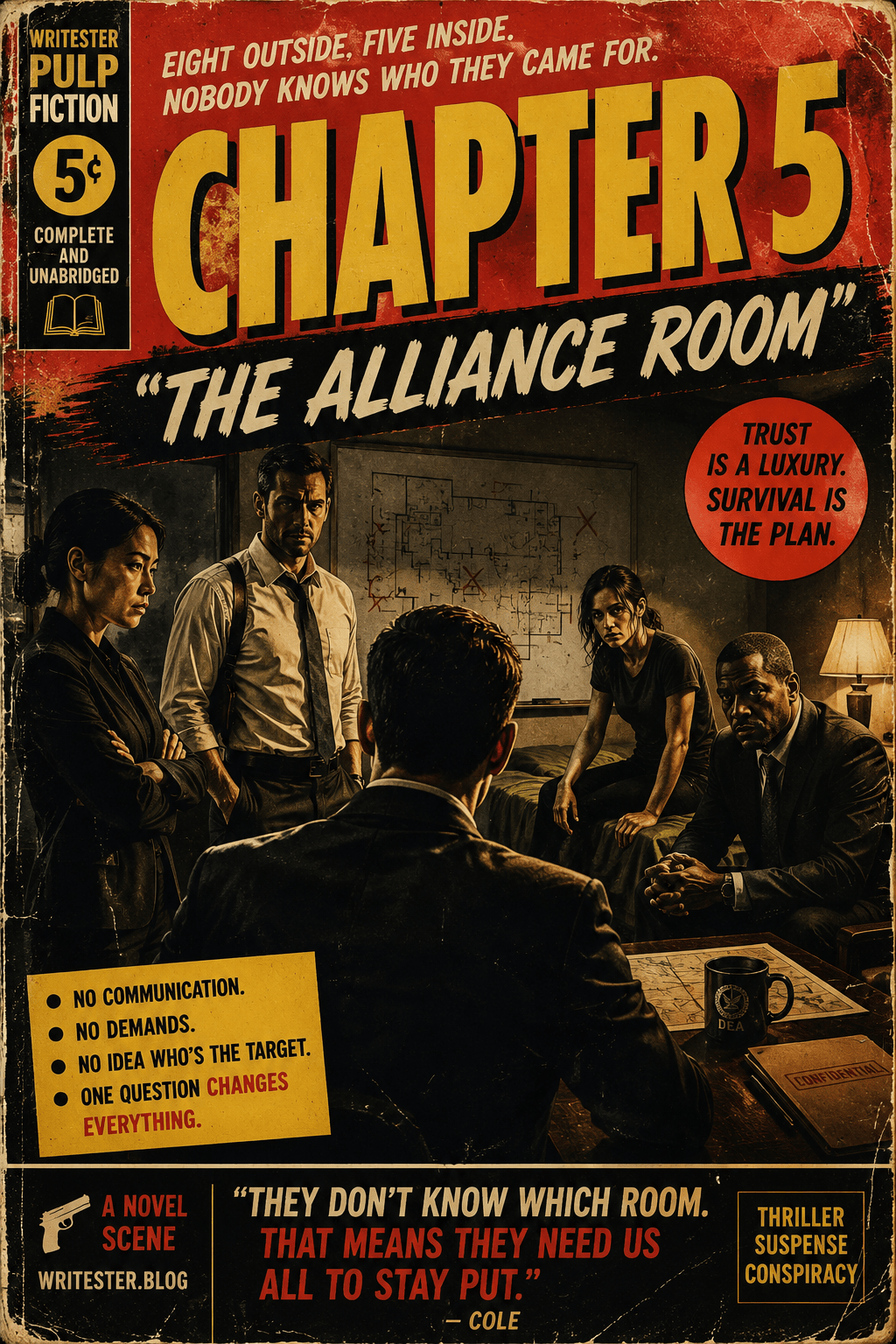
Here is Beat 5 — The Alliance Room, rendered as a complete novel chapter:
Cole had the door to Room 7 open before Kwon finished knocking.
She looked at him, then past him at Dani, who was sitting on the edge of the second bed with her arms folded and her shoes still on.
“The DEA handler,” Cole said. “Reyes. He knows?”
“He’s been awake longer than either of us.” Kwon kept her voice flat. “He’ll come.”
“And the other one?”
“Webb.” She said the name like she’d bitten into something she wasn’t sure about. “He’ll come too. He’ll just take longer.”
Cole grabbed his jacket off the chair. He looked at Dani. “You stay here.”
“No.”
“Dani—”
“You’re not leaving me in a room by myself with eight people outside who don’t have a reason to knock first.” She stood up. “I’m coming.”
He didn’t have time to argue it properly, and she knew that. He moved.
They used Room 3. Empty, east-facing, far enough from the office that sound wouldn’t carry. Cole had checked it an hour ago — no personal items, no surveillance residue, just a bed with a green coverlet and a bathroom that smelled like pine disinfectant.
Reyes was already inside when they arrived. He’d pushed one of the chairs against the wall and was standing beside it rather than sitting in it, jacket open, hand close to where it needed to be. He clocked Dani immediately.
“Who is she?”
“Mine,” Cole said.
“That’s not what I—”
“I know what you asked.”
Reyes looked at him for a moment, then looked at the wall.
Kwon came in behind them and moved to the corner without being told, which was either good instinct or a habit Cole recognised as the kind you built working confined spaces. She had a handler’s stillness. He’d noticed it the first time — the way she took up less room than she occupied.
Webb arrived four minutes later, which was three minutes later than he needed to be. He came in without apology, scanned the room, and immediately gravitated toward the centre.
“I want to be clear,” Webb started, “that whatever this is, it isn’t—”
“Sit down,” Cole said.
“I’m sorry?”
“There’s a chair. Sit in it.”
The silence had some weight to it. Webb looked at Cole with the expression of someone running a quick calculation, then sat.
Cole stayed by the door. He’d rather have the room between him and it, but that put his back to the window, and the window faced the car park. He settled for standing where he could see both.
“We have eight personnel outside,” he said. “Two vehicles, both access points covered. No communication, no demands. They jammed everything before they moved, which means this was timed and coordinated, not reactive.” He paused. “Whatever they came for is in this building.”
“Mine,” Webb said.
Reyes made a short sound. “Your what?”
“My asset. Sorokin. He has intelligence on a penetration operation that certain people would—”
“Mine’s a financial witness.” Reyes was talking over him now. “Cartel network. His testimony takes down three distribution chains. You think—”
“I think you’re both assuming,” Kwon said quietly.
Both men looked at her.
“You’re assuming you’re the reason they’re here.” Her voice was even. “That’s an assumption.”
Webb straightened slightly. “Sorokin came through channels that are—”
“I know what channels are.” She didn’t raise her voice. “I’m saying you don’t know.”
The room went quiet enough that Cole could hear the highway in the distance — something that had been completely inaudible until the car park lights died. Funny how silence worked.
It was Dani who spoke.
She’d been sitting in the corner on the floor with her back against the wall, arms resting on her knees, watching the room the way Cole had learned she watched things — not conspicuously, just continuously. She’d been so still for long enough that he thought she’d checked out. She hadn’t.
“Which one of us did they come for?”
The question landed and sat there.
Not who are these people or how do we get out or any of the tactical questions Cole had been circling since the lights died. Just that. Direct, flat, almost conversational. Like she was asking which way was north.
Webb looked at her. “Who is she, exactly?”
“She asked you a question,” Cole said.
“She’s a—”
“She asked you a question.”
Webb turned back to Dani. He seemed to be recalibrating. “We can’t know that without—”
“You don’t know,” Dani said. “None of you know. That’s the answer, isn’t it.”
She wasn’t being smart about it. That was the thing Cole had noticed early — she made observations that sounded like accusations and hadn’t yet figured out how they landed. Or she had, and she’d decided the landing didn’t matter as much as the truth.
Reyes looked at the floor. Kwon had gone very still in her corner.
“It changes the logic,” Dani said. “If they came for one of you specifically, you wait them out and see which room they hit first. But if they don’t know which room—” She stopped.
“Then they need all of us to stay put,” Cole finished.
She looked at him. “Yeah.”
Webb cleared his throat. “That’s a significant leap from available—”
“How many operations do you know of that coordinate eight-man perimeter containment with full communications blackout and no breach attempt?” Cole said. “In thirty years, I’ve seen that configuration twice. Both times the objective was to prevent communication from inside, not movement. They’re not here to take anyone out. They’re here to stop something getting out.”
The room processed that.
Reyes pulled his jacket closed. Not zipping it, just closing it. “So they’re waiting for something.”
“Or someone on the inside to do something,” Kwon said. She said it very carefully, like she was setting it down somewhere fragile.
Nobody answered that. Cole looked around the room — at Reyes with his shoulders tight and his jaw working, at Webb who had gone still in a way that felt calculated, at Kwon whose eyes were moving between faces now, reading them the same way Cole was reading them.
Nobody answered Dani’s question.
That was the thing. The room full of trained federal personnel, between them holding decades of fieldwork and institutional knowledge and whatever classified weights they’d all been carrying through the door — and nobody had an answer to what a twenty-three year old paralegal had asked in thirty words.
Cole looked at her.
She looked back at him with an expression that was almost — not quite — the same as the one she’d had in the car coming out of the holding facility, when she’d asked him why he chose this job and he hadn’t answered. She’d filed it away then. He could see her filing this away too.
Which means nobody is sure.
“Alright,” Cole said. “Here’s what we do.”






 Writester
Leave a comment