
There’s a moment most writers know well. You’ve got a premise you love, maybe even a few chapters down, and something feels off. Not broken, exactly — just hollow. Like you’re writing around something rather than toward it.
For a long time, I thought that was just part of the process. Push through, and eventually the story reveals itself. And sometimes it does. But sometimes you spend weeks — or months — circling the same drain, redrafting the same scenes, wondering why nothing feels quite alive yet.
What I didn’t expect was that an AI would be the thing that finally helped me see it.
It’s Not What You Think
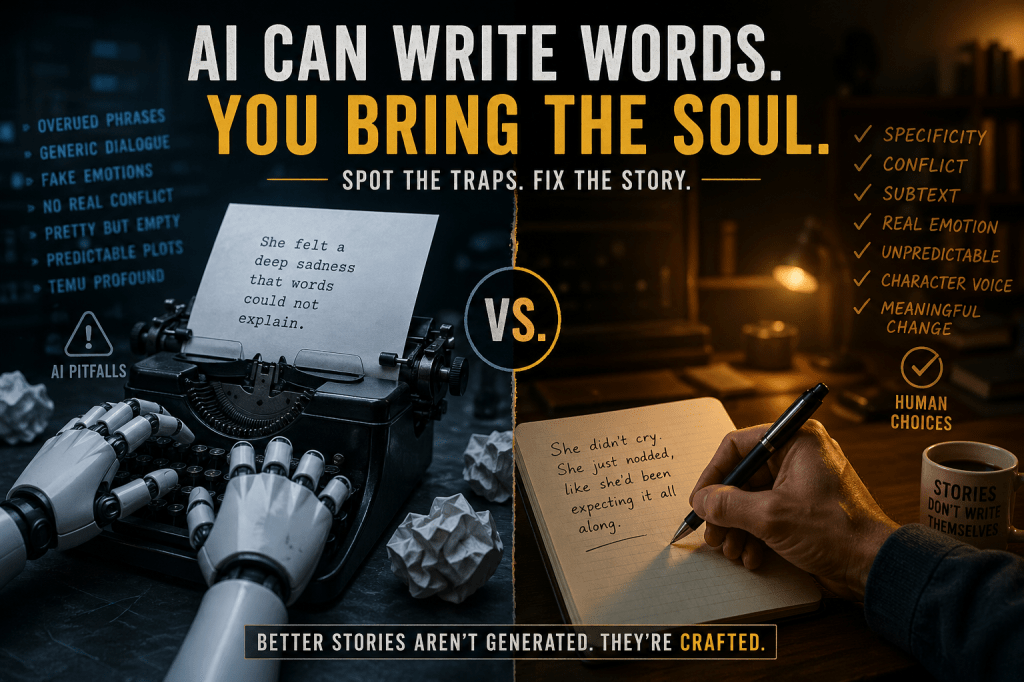
I’m not talking about AI generating your story for you. That’s not finding the heart — that’s replacing it. What I mean is something quieter and, honestly, more useful.
Try this: take your rough premise, or even just a messy chapter summary you’ve written for yourself, and paste it into an AI tool. Then ask it something like:
- What seems to be the emotional core here?
- What theme is starting to emerge from this?
- What does the protagonist actually need to learn — not just want, but need?
- What is this story really about underneath the plot?
Read the response slowly. You might find yourself nodding. Or you might find yourself wanting to argue — and that reaction is just as valuable, because arguing with a wrong answer is often how you stumble onto the right one.
Why This Works
Here’s the thing about AI: it doesn’t have your emotional attachment to the cool plot twist you’ve been building toward, or the character you’ve grown too fond of to cut. It reads what’s actually there, not what you meant to put there. That distance — which can feel frustrating when you want enthusiasm — becomes a genuine tool when you need honesty.
Writers often can’t see the forest for the trees when they’re deep in a project. We know too much. We’re carrying the backstory, the planned arcs, the deleted scenes that influenced the ones we kept. The AI only sees what’s on the page in front of it, which means it can sometimes name what you’ve been unconsciously writing toward without even realising it.
I’ve had moments where I pasted a chapter summary and the AI reflected back a theme I genuinely hadn’t consciously intended — and it was exactly right. Not because the AI was clever, but because I had apparently been writing toward that truth all along and just hadn’t let myself acknowledge it yet.
The Reflective Practice
Think of it less like a consultation and more like journaling with a very attentive reader. You’re not outsourcing your creative vision — you’re using the AI as a mirror.
After you get a response, sit with it. Ask yourself:
- Does this resonate, or does it feel completely off? (Both answers tell you something.)
- If the AI named a theme, is that the theme I want this story to carry?
- What would change in the story if I committed fully to that emotional core?
Sometimes this process confirms what you already knew but were afraid to lean into. Sometimes it reframes the whole project in a way that suddenly makes everything click. Either way, you leave the conversation knowing more about your own story than when you started.
A Word of Caution
This only works if you stay in the driving seat. The goal isn’t to let an AI define your story — it’s to use its reflection to define it yourself, more clearly and with more confidence. Your instincts, your experiences, your emotional truth are what make a story worth reading. The AI just helps you hear what you’ve already been quietly saying.
Writers have always needed readers, sounding boards, trusted friends who’ll tell them what their work is really about. AI doesn’t replace that — it just means you can have that conversation at midnight, in your pyjamas, without bothering anyone.
And sometimes, that’s exactly when the best clarity arrives.



 Writester
Leave a comment